

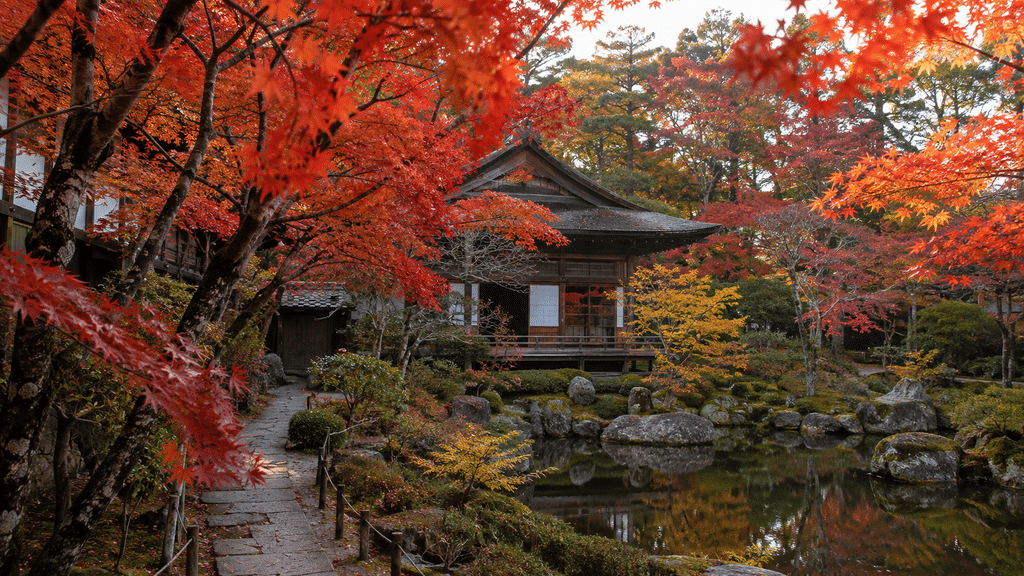
Japan in autumn 2026: the best eSIM for Kōyō season travel

Japan’s autumn foliage season is one of the most photographed travel moments on earth, and 2026 is shaping up to be the busiest one yet. A record 42.68 million people visited Japan in 2025. Even so, arrivals easing slightly this spring have not thinned the crowds chasing kōyō (autumn colour) from Hokkaido to Kyoto. Maybe you already booked a ryokan for late November. Maybe you are still deciding between Kyoto’s maples and Hokkaido’s early snow-dusted reds. Either way, the moment you land, your phone becomes your ticket, your map, your translator and your tax refund receipt all at once. Here is the eSIM Japan setup built for exactly that.
Overtourism, a later foliage peak and a new tax-free rule all land in the same few weeks this year. As a result, the kōyō season is the toughest connectivity test Japan sees all year. Get your eSIM ready before you fly.
Why autumn is Japan’s toughest connectivity test of the year
Overtourism in Japan did not disappear in 2026, it just concentrated. Inbound arrivals actually dipped 5.5% year on year in April. Even so, pressure is still piling up in the same handful of places: Kyoto, the Mount Fuji area and a short list of historic districts. Tokyo has responded with a revised national tourism plan, approved in March 2026. Concretely, it aims to get 100 regions actively managing crowding by 2030 through better flow management rather than hard caps or entry fees. For now, until that plan changes anything on the ground, autumn weekends in Kyoto’s temple districts will keep feeling like a queue. A patchy signal in a packed alley is the last thing you want when you are also trying to find the next train.
When and where kōyō season peaks in 2026
Japan’s autumn colours are running later than usual this year. The Japan Meteorological Agency forecast an above normal summer through August 2026. As a result, leaves are turning later: they only change once there have been five consecutive nights below 8°C. That pushes the whole season three to five days later than historical averages. Here is roughly where things stand region by region.
| Region | Typical 2026 peak | Known for |
|---|---|---|
| Hokkaido (Daisetsuzan) | Mid-September | First colours of the season, alpine parks |
| Nikko and the Kanto highlands | Early October to mid-November | Lake Chuzenji, Kegon Falls, the Irohazaka road |
| Tokyo (urban parks) | Late November to early December | Meiji Jingu Gaien, Rikugien, city-centre maples |
| Kyoto and the Kansai region | 25 November to 7 December | Arashiyama, Tofuku-ji, Kiyomizu-dera |
| Kyushu | Mid-December | The last colours of the Japanese archipelago |
If you are still deciding when to fly, that later peak buys you a little room, but not much. Premium ryokans in Kyoto for the 20 to 30 November window are expected to be fully booked by August 2026. That is because most open reservations exactly six months out. Lakeside ryokans near Chuzenji tend to sell out around three months ahead. Book your stay first, then build your connectivity around it.
Find your eSIM before the kōyō rush
 Japan
Japan


- Less than a week
- 7-14 days
- 15-29 days
- 30 days or more
- Show all
- 5 Go or +
- 10 Go or +
- 20 Go or +
- 50 Go or +
- 100 Go or +
- Unlimited
Your eSIM Japan starts working before you clear immigration
Visit Japan Web lives in your account, not on your device
Visit Japan Web is not mandatory. Paper arrival and customs cards are still handed out on the plane and accepted at the airport. But the fast lane runs on a single QR code that is generated inside your online account rather than stored offline. That means you need to actually log in and pull it up when you land. Arriving with a working connection is the easy way through that fast lane. That beats hunting for airport wifi at 11pm after a 12-hour flight.
A new tax-free rule kicks in from November 2026
Japan’s tax-free shopping system is changing on 1 November 2026. Specifically, it moves from an instant discount at the till to a refund claimed digitally at departure. If your autumn trip crosses that date, expect to track purchases and file the refund online. In other words, you will not walk out of a shop already tax-free. That is one more reason your data plan needs to be active well before your flight home, not just for the arrival.
Autumn’s best moments run on apps, not paper tickets
Reserved seats on the Shinkansen fill up fast once kōyō season is underway. These days, most travellers book them through an app rather than a station counter. Likewise, night illumination events at temples like Kiyomizu-dera or Eikan-do, some of the most photographed moments of the season, increasingly run on timed, digital-only entry. Add restaurant bookings through apps and a Google Maps route recalculated every time a train gets delayed. Put together, it is clear why a dead phone battery matters less than a dead data connection. None of this needs a huge amount of data on its own. What it needs is to be always available, which is exactly what a local eSIM is built for.
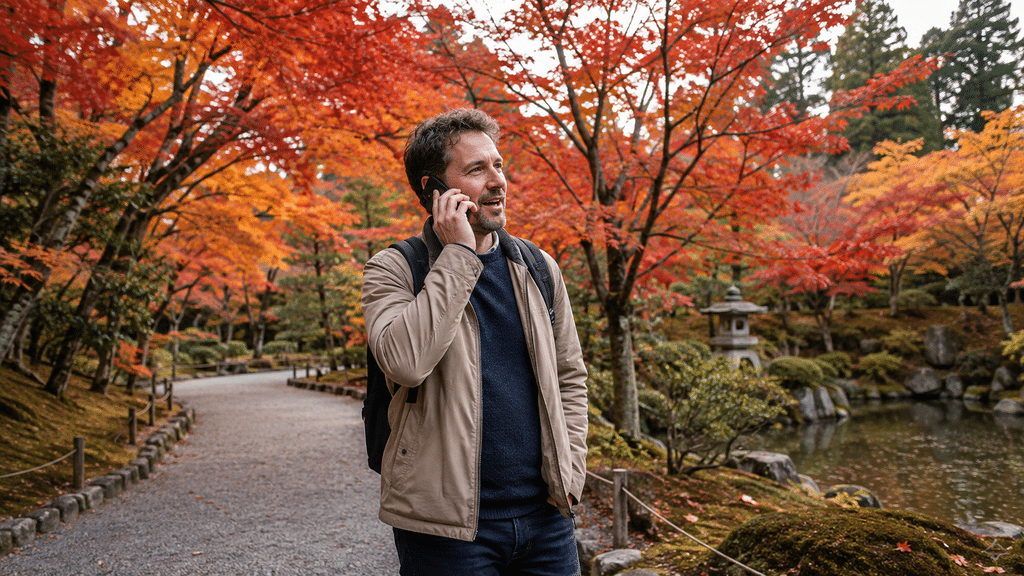
Local, regional or global: which eSIM fits an autumn trip to Japan?
Japan is a straightforward one-country trip for most autumn visitors. As a result, a local eSIM is usually the sharpest choice on price per gigabyte. It is a different call if the kōyō season is only one leg of a longer swing through the region.
| eSIM type | Best for | Trade-off |
|---|---|---|
| Local (Japan only) | A dedicated kōyō season trip, one country | Lowest cost per GB, but no coverage once you cross a border |
| Regional (Asia) | Combining Japan with Korea, Taiwan or the wider region | Mid-range price, less sharp than a local plan for Japan alone |
| Global | An autumn trip that continues well beyond Asia | Highest coverage, but you pay for data you will not use in Japan |
How much data an autumn trip to Japan actually needs
Budget 500 to 700 MB a day for an average sightseeing day: maps and navigation, a bit of translation camera use, social media and checking a restaurant menu. Scaled up, that is roughly 2 to 3 GB for a long weekend, 5 GB for a full week and 10 GB for two weeks. For a full month chasing the colours from Hokkaido down to Kyushu, plan on 20 GB. Translation apps are the detail most people underestimate: the camera mode alone can burn 20 to 30 MB an hour. As a result, roughly one in four travellers (26%) run out of data or have to top up mid-trip in Japan. Add a 20 to 30% buffer on top of whatever you calculate. Or, read our full guide on how much data you need for travel to fine-tune it by trip type.
Temple queues and mountain roads: 3 rules for staying connected
Kyoto’s back streets during peak kōyō weekends and Nikko’s forested switchbacks have almost nothing in common. Yet both can leave you staring at a spinning wheel exactly when you need directions.
- Activate before you fly, not at the arrivals gate. Most eSIM plans only start counting data once you actually use them, so there is no cost to installing yours at home. See our step-by-step activation guide if it is your first time.
- Favour multi-network coverage for rural stops. Japan runs on three main carriers, NTT Docomo, SoftBank and au (KDDI), and coverage in mountain foliage spots like Nikko or backcountry Hokkaido can vary between them. An eSIM that can fail over between networks copes far better than one tied to a single carrier.
- Keep a data buffer for the boring apps. Your Suica or Pasmo digital transit card, hotel booking confirmations and last-minute seat reservations for the Shinkansen all quietly draw on the same allowance as your photos.
How to call and text in Japan with a data-only eSIM
Most travel eSIMs for Japan, ours included, are data-only. For the vast majority of autumn visitors, that is not a real limitation. WhatsApp and VoIP apps cover calls home without issue. Once you land, you will also notice LINE is the app locals actually use for everything from group chats to restaurant reservations. If you specifically need a real local phone number for calls and SMS, BNESIM is one of the few partner operators in Japan that supports it directly.
Not sure your phone is ready?
Most phones from the last few years support eSIM, but it is worth checking before you fly rather than at the airport. See our guide on how to check eSIM compatibility. Or, if you are still deciding between the two, read our explainer on the difference between an eSIM and a physical SIM card.
Compare eSIM plans for your kōyō season trip
FAQ: eSIM for Japan in autumn
When is the best time to see autumn colours in Japan in 2026?
It depends where you go. Hokkaido turns first, around mid-September, while Kyoto peaks much later, between 25 November and 7 December. Most of the country, including Nikko and Tokyo, sits somewhere in between through October and November.
Do I need a Japan-only eSIM or a regional Asia eSIM?
If Japan is your only stop, a local Japan eSIM is almost always cheaper per gigabyte. Only switch to a regional Asia plan if you are also visiting Korea, Taiwan or elsewhere in the region on the same trip.
Will my eSIM work in rural areas like Nikko or Hokkaido during kōyō season?
It should, but coverage between carriers is not identical outside major cities. A multi-network eSIM handles patchy rural signal noticeably better than a plan locked to one carrier.
Is Visit Japan Web still required in 2026?
No, it remains optional. Paper cards are still accepted, but the QR code for the fast lane lives in your online account. That means you need a working connection to access it when you land.
How much data do I need for a 10-day autumn trip to Japan?
Budget around 7 to 8 GB for ten days of average sightseeing, translation and navigation. Also add a buffer, since roughly a quarter of travellers underestimate translation and hotspot use. See our full data guide to fine-tune it.
Can I keep my usual phone number while using a Japan eSIM?
Yes. The eSIM runs alongside your primary SIM. As a result, your regular number stays reachable for calls and texts while your data runs through the new plan. For more on how the two coexist, see what an eSIM is and how it works.
Chasing kōyō across three or four regions, or planning to keep travelling once the leaves are behind you? Our guide to the best eSIMs for international travel covers what changes once you leave Japan. Meanwhile, our full destinations directory covers everywhere else on your route.
Comparison table
| Provider | Price (USD) | Data (GB) | Validity (days) | Best for | Network |
|---|---|---|---|---|---|
| Airalo | 5-20 | 1-10 | 7-30 | Budget, short trips | Vitelle |
| Nomad | 6-30 | 1-20 | 7-30 | Flexible plans | Vitelle |
| Yesim | 4-25 | 1-10 | 7-30 | Budget travelers | Vitelle |
| Holafly | 19-45 | Unlimited | 5-30 | Heavy data use | Vitelle |
| Jetpac | 15-40 | Southeast Asia | 7-30 | Regional travel | Multi-network |
Can you keep your personal number while using an eSIM?
Yes, you can. With dual SIM mode, your physical SIM card can handle calls and texts, while your eSIM provides mobile data during your stay in Japan.
Are eSIM providers reliable?
Before switching to an eSIM, check whether you can also keep your old SIM card. Read our guide: Can I use an eSIM and a regular SIM card at the same time
All providers listed on esimseeker.com have been tested and reviewed. Go with well-known brands like Airalo, Nomad and Holafly for extra peace of mind and real customer support.
Can you make calls or send texts with an eSIM in Japan?
Using VoIP and messaging apps
Most eSIMs are data-only, meaning you won’t get a local number. But you can make calls through WhatsApp, FaceTime, Skype, or similar apps with your mobile internet connection.
eSIMs with call & text support
Some providers offer add-ons for calls and SMS, but they are rare and not always necessary. If voice calls are important, consider using VoIP apps or getting a local SIM.
Do Japan eSIMs come with a local number?
Typically no. eSIMs like Airalo or Holafly offer data only, which is fine for most tourists. If you need a Japanese number for verification, use a local prepaid SIM.
Network coverage and data speeds in Japan
Which providers offer the best 4G/5G?
NTT Docomo offers the best 4G and 5G coverage, including in rural and mountain areas. Most travel eSIMs for Japan run on SoftBank’s or Docomo’s network for strong performance. au (KDDI) also offers competitive speeds in major cities.
NTT Docomo vs SoftBank vs au (KDDI)
- NTT Docomo: best coverage in cities and rural areas
- SoftBank: strong 4G, the network most travel eSIMs run on
- au (KDDI): solid urban coverage, a bit weaker rural reach
eSIM performance: Airalo, Nomad & others
Airalo, Nomad and Holafly mainly run on SoftBank’s or Docomo’s network in Japan, so speed and reliability are excellent for everyday use including streaming, video calls, and browsing.
Alternative SIM options for Japan
Local prepaid SIM cards
You can buy SIM cards at the airport or local shops from NTT Docomo, SoftBank, or au (KDDI). They’re cheap but less convenient than eSIMs.
International prepaid SIMs
Some companies offer physical SIM cards you can buy before you travel. These are bulky and more expensive than eSIMs.
Travel eSIMs vs roaming
Roaming is usually much more expensive than using a travel eSIM. If you’re asking what is data roaming, it’s when your phone uses mobile data outside your home country. This often leads to high fees unless you deactivate roaming or use an eSIM.
At esimseeker, we believe eSIMs are the smartest way to stay connected when traveling. Whether you’re backpacking or working remotely, there’s an eSIM plan that fits your needs.
Use our Japan eSIM comparison tool to explore real-time offers, prices and reviews. Don’t forget to check our guides for other destinations too.